

NHS England launches supplier registry for AI scribing tech
- 16 January 2026


- NHS England has published a self-certified registry for ambient voice technology (AVT) suppliers to show evidence of compliance
- The registry requires suppliers to comply with standards on clinical safety and data protection
- A London-wide study showed the technology could bring 'transformative benefits' to patients and clinicians
NHS England has today published a national self-certified registry for ambient voice technology (AVT) suppliers to show evidence of compliance.
AVT is key to the government’s NHS 10 year health plan and NHS England published guidance last year advising clinicians to use the AI scribing tools, which capture clinician–patient conversations and use AI to generate real-time transcriptions and clinical summaries.
The supplier registry, first announced in October, requires suppliers to comply with standards on clinical safety, technology, and data protection.
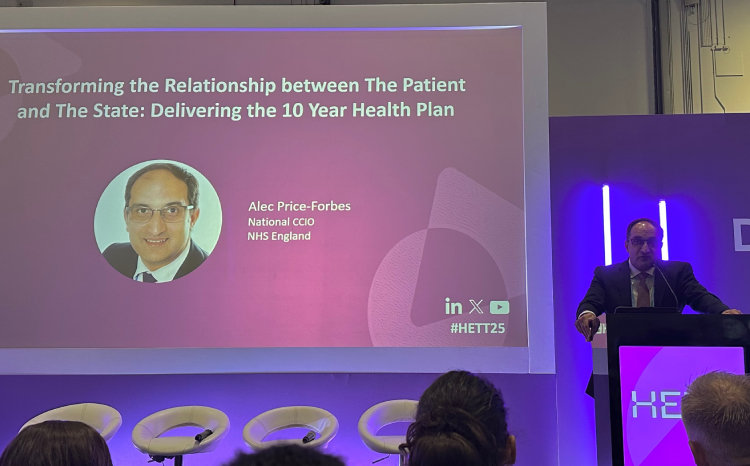
Dr Alec Price-Forbes, NHS England national chief clinical information officer, said: “The AI revolution is here and we want to arm our NHS staff with the latest technology, which has the potential to transform the quality, safety and experience of care patients receive, as well as improving efficiency.
“AI notetaking tools will help free up more time for clinicians to focus on their patients, rather than typing up notes or looking at a screen – enhancing the quality of consultations and improving overall patient satisfaction.
“We are working with NHS organisations to help them implement the technology safely and effectively – helping to make the NHS the most AI-enabled healthcare system in the world, as we shift from analogue to digital.”
An NHS England sponsored study, published in September, found that AI-scribing technology can reduce clinician workload while improving patient care, with the potential to unlock millions of pounds worth of activity if rolled out nationally.
The study, led by Great Ormond Street Hospital for Children NHS Foundation Trust’s Innovation Unit, was conducted across nine NHS sites in London to assess the impact of the TORTUS AI-scribing tool.
More than 17,000 patient encounters were evaluated across sites including hospitals, GP practices, mental health services, and ambulance teams.
Results showed a 23.5% increase in direct patient interaction time during appointments, alongside an 8.2% reduction in overall appointment length when AI-scribes were used. A&E saw a 13.4% increase in patients seen per shift.
Dr Layla McCay, director of policy at the NHS Confederation, said that healthcare leaders will the new registry and access to AI tools that comply with clinical safety and data standards, but added that “some organisations may have poor or incompatible infrastructure for AVT tools, while others lack reliable WiFi and secure platforms”.
“Continued capital investment is therefore vital to ensure the NHS can develop and maintain the infrastructure needed to make the most of AI technologies.
“NHS staff also need appropriate training to learn how to use these tools effectively,” McCay said.
Firms to release AVT scribing solutions include Accurx, Tandem Health, Microsoft, HEIDI Health and Aide Health, among many others.
However, the technology’s adoption has been held back by regulatory uncertainty. In June 2025, Price-Forbes wrote to NHS bodies advising caution about the use of unregulated AVT, leading the British Medical Association to advise GPs to pause use of the technology unless they have carried out data protection and safety checks.
Meanwhile, a national commission was launched in September 2025 to advise the Medicines and Healthcare products Regulatory Agency on speeding up access to the latest AI tools, including AVT.