
Brainwave reader developed for motor neurone disease patients
- 5 March 2025


- Nottingham Trent University has developed a brainwave reader for people who can no longer communicate through speech or eye movement
- The technology uses the power of thought by interpreting people’s brain signals when they are invited to envisage imaginary situations to indicate ‘yes’ or ‘no’ answers
- The brainwave reader can help patients with advanced motor neurone disease
Nottingham Trent University (NTU) has developed a brainwave reader for people who can no longer communicate through speech or eye movement, such as motor neurone disease (MND) patients.
The technology uses the power of thought by interpreting people’s brain signals when they are invited to envisage imaginary situations to indicate ‘yes’ or ‘no’ answers.
For example, patients can be asked to imagine the joy of kicking a football to indicate ‘yes’, but by contrast be asked to imagine being trapped in a room with an elephant to mean ‘no’.
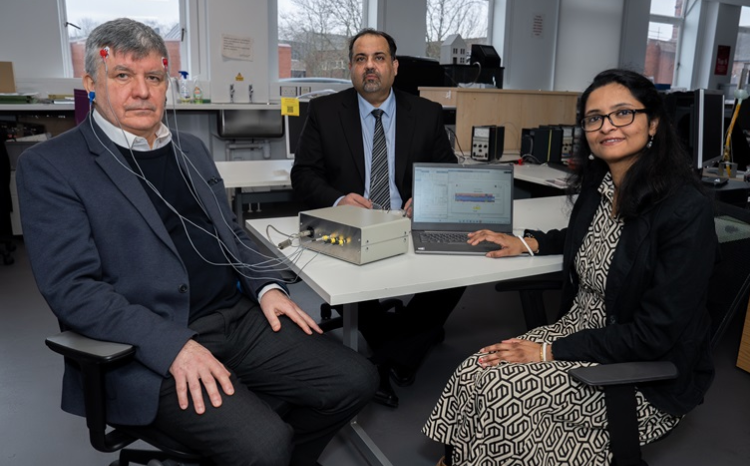
The diverse imaginations, which produce different analogue signals in the brain, are detected over five seconds by three electroencephalogram (EEG) sensors attached to the patient’s head.
These analogue signals are then magnified and converted to digital signals before being interpreted by the AI and relayed to a display screen to show the answer.
Professor Amin Al-Habaibeh, an expert in intelligent engineering systems from the School of Architecture, Design and the Built Environment, wanted to support charities which help people with advanced MND and Completely Locked-in Syndrome after his brother-in-law, Naeem Radwan died aged 38 after having MND.
The research has led to the development of a brainwave reader which is made affordable by using off-the-shelf parts and a novel AI algorithm developed by the research team.
“This technology can allow people who are in the late stages of MND to communicate critical information when they are unable to even blink,” Professor Al-Habaibeh said.
“It could be used for a variety of purposes, such as to communicate what a patient’s wishes may be, whether they are comfortable, if they would like any further medication, and more.
“Our aim is to make this technology affordable for organisations such as charities so that it can be used more widely by families or hospices, rather than as a commercial venture.
“By allowing better communication in the later stages of MND, it will also allow medical professionals to treat patients better and take key decisions which are in line with the patient’s wishes,” he added.
This approach could also allow a patient to control a cursor on a computer screen in the future, potentially with just four imaginations for up, down, left and right.
With further research, it may also be possible for this technology to be applied to mental health outputs, including detecting levels of stress.
Dr Ahmet Omurtag, project co-supervisor from NTU’s School of Science and Technology, said: “Existing medical EEG devices tend to be expensive, so I think the capability to decipher people’s thoughts using only a few sensors will continue to increase in value and find more applications.”
In 2023, Innovate UK awarded Sano Genetics a grant of £330,000 to support the development of a new platform aimed at people who are at risk of MND.