

NHS SE London uses data to plan women’s and girls’ health hubs
- 10 July 2025
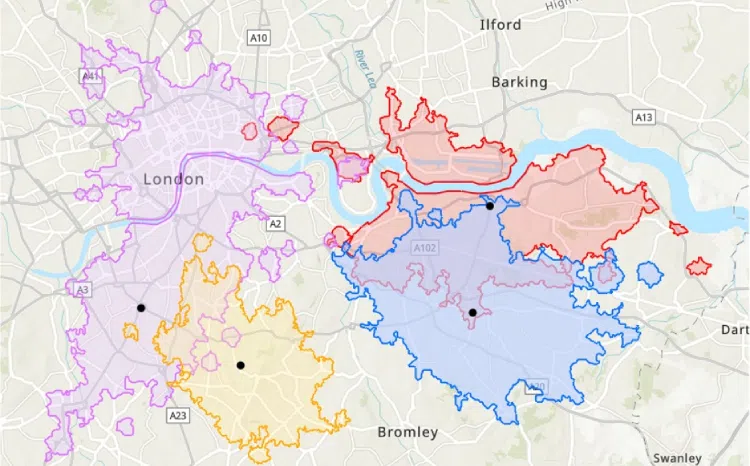


- NHS South East London has identified the best sites for its first two women's and girls' health hubs using spatial analysis
- The hubs are designed to improve access to services and reduce inequalities in women's and girls' health
- NHS SE London's data analytics team used Esri UK's geographic information system software to conduct the analysis instead of working with the usual isolated charts and tables
NHS South East London has identified the best sites for its first two women’s and girls’ health hubs using spatial analysis.
The hubs, which are designed to improve access to services and reduce inequalities in women’s and girls’ health, offer key health services, including menstrual care, menopause support, pre-conception care, and awareness of breast and cervical cancer.
By examining service usage and demographic data across six boroughs, precise locations in Lambeth and Greenwich were revealed that would benefit most patients and help improve outcomes.
NHS SE London’s data analytics team used Esri UK‘s geographic information system (GIS) software to conduct the analysis instead of working with the usual isolated charts and tables.
Alice Gough, programme manager, women’s and girls’ health hubs, at South East London Integrated Care System and King’s Health Partners, said: “Using Esri applications to visualise the burden of conditions like fibroids and endometriosis at a neighbourhood level has been invaluable.
“It highlights unmet need and helps us shape our community outreach programmes and women’s and girls’ health hub service design around the communities that need it most.”
The new approach enabled disparate data to be integrated and patterns within the data to be easily seen, helping to understand access issues and support the final planning decisions.
Lambeth’s hub operates as a virtual triage model, with plans to transition to an in-person hub based within an existing GP practice.
The new Greenwich site is located within an existing community health centre alongside sexual, reproductive, and contraception health services.
The spatial analysis examined existing patient-level service usage, for long-acting reversible contraceptives, heavy menstrual bleeding and menopause treatments, in primary and secondary care.
In addition, demographic data such as deprivation data is being examined, all at lower layer super output areas, the most granular data available.
Journey time analysis was also considered to make the sites as accessible as possible. This allowed the analytics team to see which potential sites should be examined further, making use of existing buildings within the estate to optimise the use of space.
Duncan Booth, head of health and social care at Esri UK, said: “Location is a powerful way of integrating disparate datasets to understand demand and plan new health services.
“Adopting a geospatial approach is increasingly delivering value across the NHS as more organisations move to digital to help reduce backlogs and increase prevention.”
The women and girls health hubs accept referrals from GPs and individuals self-referring, reducing the need for hospital visits and improving access to timely support.
Plans for the project include looking at what new data could be added to the analysis, such as cervical screening, referrals to secondary care gynaecology services and sexual health data.