
It’s not technology that makes or breaks an EPR go-live
- 23 February 2026



An EPR go-live is one of the hardest things a hospital will ever do, writes Andy Callow, chief digital and transformation officer at Nottingham University Hospitals NHS Trust
Electronic patient record (EPR) programmes are often described as technology projects, discussed in terms of systems, modules, integrations, and performance.
But after living through a major EPR go-live at Nottingham University Hospitals, I’m convinced that the real success or failure of these programmes has very little to do with the technology itself.
What makes or breaks an EPR go-live is leadership, trust, and the strength of relationships across the system.
That might sound trite, but it’s true.
An EPR is the most complex thing a hospital can choose to do. It touches every part of the organisation, every clinical pathway, and every member of staff.
An EPR go-live is open heart surgery on the operational core of the hospital carried out while the organisation continues to function
It’s not a new piece of kit or a departmental system. It’s open heart surgery on the operational core of the hospital, carried out while the organisation continues to function.
In our case, the go-live represented the culmination of more than a decade of work.
It wasn’t a classic ‘big bang’ replacement of one system with another. It was an evolution of a long-standing partnership and a deliberate attempt to build a foundation for the future rather than chase short-term transformation headlines.
The real value of an EPR is not what happens on day one. It’s what becomes possible afterwards.
For the first time, we now have a single platform across inpatients, outpatients, theatres, and complex pathways.
That means clinicians can see the full patient journey in one place. It means we can start to use data to improve care in ways we simply couldn’t before.
And, critically, it creates the foundation for joined-up working across organisations.
The real prize is visibility across the whole pathway, not just within the walls of a single hospital.
Bumps in the road
But none of that removes the reality that go-live periods are hard. There will always be bumps in the road.
We experienced performance issues in the early days after go-live, despite extensive preparation. For a short period, it was tough for both patients and staff. That has to be acknowledged honestly.
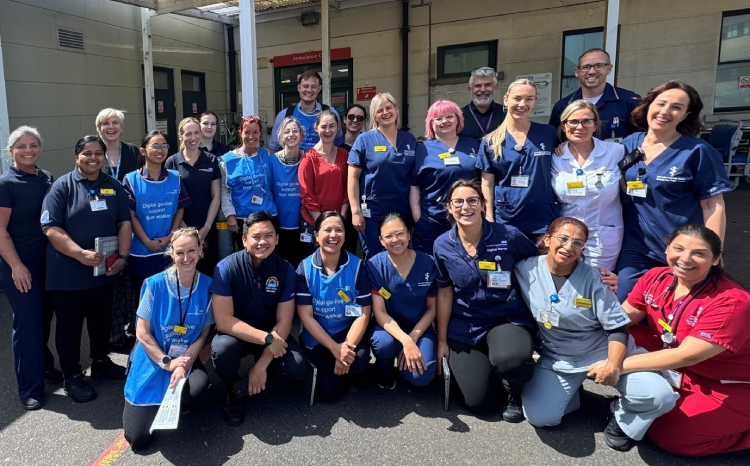
What mattered most in those moments wasn’t the technology. It was the team.
In some of the most difficult hours, you could look around the room and not tell who was from the trust, who was the supplier, and who was the delivery partner.
Everyone was working towards the same goal: stabilising the system and keeping services running.
During the days that followed our go-live, we made a conscious decision to communicate openly about what had gone well and what hadn’t
There was no blame culture. No one retreating into contractual positions. Just people pitching in together to solve problems.
That kind of environment doesn’t happen by accident. It’s built over years of relationships, honesty, and shared purpose, and it’s what allows an organisation to get through the inevitable difficult moments.
Another lesson was the importance of realism. If your threshold for go-live is perfection, you will never go live.
There is always another issue to fix, another workflow to refine, another report to build. At some point, leadership has to make a judgement call: we are ready enough, and the benefits of moving forward outweigh the risks of delay.
That requires courage. It also requires honesty with boards, staff, and partners about the fact that the early days will not be perfect.
Transparency matters. During the days that followed our go-live, we made a conscious decision to communicate openly about what had gone well and what hadn’t. That included public reflections on the experience.
It would have been easy to go quiet, but openness builds trust. And trust is the currency of large-scale change.
Exciting possibilities
Looking ahead, the most exciting possibilities are not about digitising existing processes. They’re about fundamentally changing the relationship between patients and the health system.
A modern EPR opens the door to proper patient-facing digital services: apps that allow people to manage appointments, interact with clinicians, and take more ownership of their care.
It also makes true system working possible, where organisations across a region can see the same patient information and coordinate care more effectively.
Those ambitions around patient empowerment and integrated care are talked about at every conference, but without the digital foundations, they remain slogans rather than reality.
Ambitions around patient empowerment and integrated care remain slogans without the digital foundations
So if I had to offer one piece of advice to other organisations embarking on this journey, it wouldn’t be about technology choices or programme plans.
It would be this: build a team you trust completely, across organisational boundaries, and give them a shared purpose.
You need people who will tell you the truth, even when it’s uncomfortable. People who will make decisions in the best interests of patients and the organisation, not their own contracts or reputations. And people who will stand shoulder to shoulder when things get difficult.
Because they will get difficult.
An EPR go-live is one of the hardest things a hospital will ever do. But if you get the culture, leadership, and relationships right, it also becomes one of the most powerful foundations for the future of patient care.
And that’s worth the discomfort along the way.