

Can the NHS 10 year health plan fix health tech procurement?
- 23 July 2025


The plan has created an unprecedented opportunity to reverse the UK’s healthcare innovation exodus, writes the National Robotarium’s Lisa Farrell
Last November, I highlighted that NHS procurement barriers were driving promising UK healthcare robotics companies’ products overseas instead of being adopted domestically.
The newly published NHS 10 year health plan for England doesn’t just acknowledge this problem, it commits to a fundamental shift needed to reverse what the National Robotarium, the UK’s centre for robotics and AI at Heriot-Watt University, has termed an “innovation exodus.”
While recent analysis has rightly highlighted concerns about implementation details, there’s an important untold story about how the plan’s transformation from viewing industry as ‘sellers’ to ‘collaborators’ could address a specific, costly problem that’s been pushing UK innovation abroad for years.
Innovation exodus
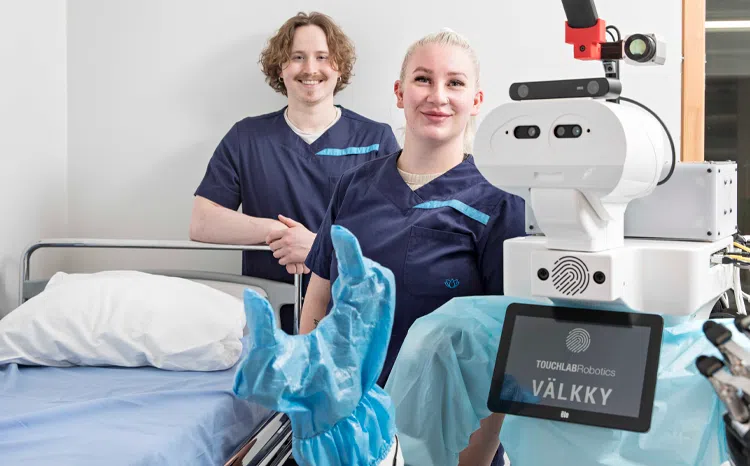
The scale of this exodus is both significant and measurable. Most recently, UK-developed telerobotic technology that enables clinicians to remotely examine patients has found its first applications in European hospitals rather than NHS trusts.
Innovative stroke rehabilitation devices, created with UK public investment, have been forced to seek North American markets when domestic procurement pathways proved inaccessible.
Meanwhile, robotic rehabilitation coaches designed to support stroke survivors are being trialled in Austria rather than UK hospitals, and socially assistive robots have found their testing grounds in French healthcare facilities instead of NHS wards.
This represents a double loss. UK patients miss out on potentially life-changing innovations, while the economic benefits – intellectual property, skilled jobs, supply chain development – flow overseas rather than strengthening our domestic economy.
When each UK robotics company scales in Europe or North America instead of here at home, we lose the multiplier effects that could support thousands of high-skilled jobs.
Partnership models that work
The 10 year health plan’s commitment to “genuine partnerships” where the NHS becomes a “collaborative partner in making innovation happen” represents a fundamental shift.
True collaboration means moving beyond the current model where companies develop solutions in isolation and then navigate complex procurement processes.
Instead, genuine partnership involves NHS trusts working with robotics and technology companies from the problem definition stage – clinicians, engineers, and NHS managers collaborating to identify needs, co-develop solutions, and plan implementation pathways together.
On paper, the plan’s Regional Health Innovation Zones provide the perfect testing ground. According to Wes Streeting, these zones will have “permission and flexibility to be more radical” with powers to “experiment with new commissioning models” and “simplify procurement.”
However, success will depend on ensuring these zones aren’t fragmented into financially constrained silos. The challenge lies in balancing regional innovation that addresses local healthcare needs with national-scale programmes that can drive the transformative robotics adoption the NHS requires.
Without sufficient scale, even the most innovative regional approaches risk becoming isolated pilot projects rather than the catalysts for system-wide change.
Furthermore, the plan’s emphasis on commissioning industry to deliver services “on a payment for outcome basis” could create challenges for healthcare robotics companies, potentially requiring them to guarantee measurable improvements in patient outcomes or staff efficiency.
While outcome-based commissioning aims to align incentives with patient benefit, it may paradoxically increase NHS costs as companies build risk premiums into their pricing models. This shift from purchasing proven technology to commissioning guaranteed outcomes fundamentally changes the commercial landscape for robotics providers.
More promising, however, is the expanded NICE process for devices and digital products – due to come into effect from next year – which creates another collaboration opportunity.
Rather than navigating fragmented local procurement, robotics and technology companies will have a clear national pathway with “accelerated commercial support” and “intensive adoption and pathway transformation support.”
Intelligent procurement
The plan’s requirement for NHS organisations to reserve 3% of budgets for transformation investments creates dedicated funding streams – potentially £6bn annually – specifically for technologies that deliver long-term benefits.
This addresses a key challenge whereby innovations often require investment in one part of the service while delivering benefits elsewhere.
It’s about building the ecosystem that could make the UK a global leader in healthcare technologies
More significantly, the plan positions the NHS as a strategic economic actor, not just a healthcare provider. The commitment to “open innovation approach” that will “unlock the extraordinary potential of our HealthTech and MedTech sectors” recognises that intelligent NHS procurement can drive UK economic growth.
By 2029, the plan commits to establishing national registries for robotic surgery data and developing telesurgery networks – creating the infrastructure for scaled robotics adoption.
This isn’t just about individual innovations; it’s about building the ecosystem that could make the UK a global leader in healthcare robotics and technologies.
Making implementation work
The plan, therefore, creates genuine opportunities. But success depends on overcoming practical considerations that have historically limited innovation adoption. The transformation from lowest-cost to value-based procurement requires evaluation frameworks that can assess robotics’ complex benefits; from infection reduction to staff retention. The promised “value-based procurement guidance” must be detailed enough to help procurement teams understand long-term value, not just immediate costs.
Procurement professionals need to understand robotics’ strategic value, while clinical champions must bridge technical-clinical divides
Cultural change represents another important factor. The plan states that “failure of the NHS to partner, and any sign of a ‘not invented here’ mentality, will not be tolerated.”
Supporting this transformation requires training, incentives, and leadership commitment. Procurement professionals need to understand robotics’ strategic value, while clinical champions must bridge technical-clinical divides.
Multi-year commitment is equally crucial since healthcare robotics often deliver benefits over multiple years. The plan’s commitment to multi-year budgets supports this need, though implementation depends on broader NHS financial reforms that face ongoing challenges.
Practical next steps
For this transformation to succeed, both NHS trusts and robotics companies must adapt their approaches. NHS trusts should use Innovation Zones and transformation budgets to experiment with collaborative development models; engaging robotics companies during problem identification, not just procurement.
Robotics companies, meanwhile, will need to potentially navigate a shift toward outcome-based commissioning while demonstrating clear value propositions. This may require developing robust evidence bases for their technologies’ impact, alongside flexible commercial models that can accommodate the NHS’s evolving procurement approaches.
The concept of a formal “Robotics for Health Partnership” – a delivery vehicle connecting NHS needs directly with UK robotics developers – could accelerate this transformation by providing structured pathways for collaboration, shared evidence bases, and coordinated adoption support that helps companies navigate these new commissioning challenges.
Seizing the opportunity
Overall, the 10 year health plan creates an unprecedented opportunity to reverse healthcare innovation’s exodus.
The policy framework finally aligns with the economic imperative to support domestic innovation. Success requires practical changes to procurement, cultural shifts toward genuine partnership, and sustained commitment to prioritise long-term economic benefits over short-term cost considerations.
The innovations that could transform patient care are ready. The policy commitments are in place. The economic and clinical benefits are too significant to ignore. The question now is whether we can finally solve healthcare innovation’s procurement problem – or whether we’ll watch another generation of UK breakthroughs find their home in overseas markets.
The choice, and the opportunity, is ours to seize.