

NHS must stop making life ‘difficult for innovators’
- 1 April 2026
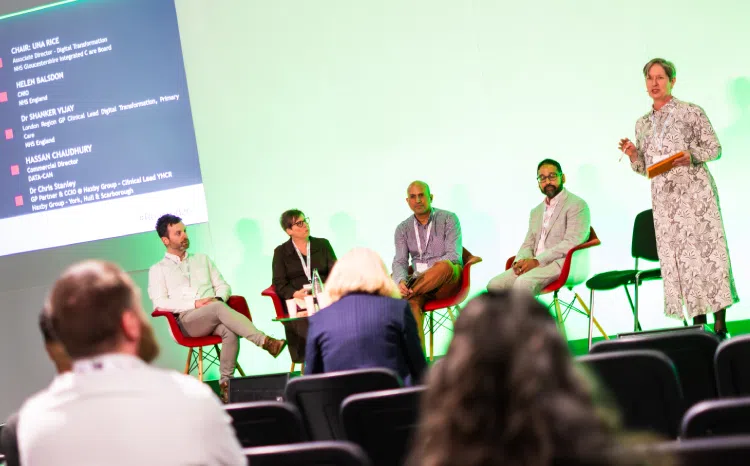


- The NHS is still a 'difficult' environment for digital innovation, panellists at Rewired 2026 said
- National CNIO Helen Balsdon claimed that leaders need to be 'braver' and more open about failure
- Legacy barriers should be 'engineered out', Hassan Chaudhury argued
Digital leaders have called for a more “brave” and “honest” approach to the barriers that prevent scaling of technologies.
Speaking in the closing session of Digital Health Rewired 2026 on next steps to deliver the 10 year health plan, Hassan Chaudhury, commercial director at DATA-CAN, said there was a failure to be “intellectually honest” about the barriers standing in the way of innovation.
These included unnecessary variety in NHS processes and job titles and the burden of legacy technology. From the innovator’s perspective, there is “no easy way” to sell the same technology to different NHS organisations, he said.
“[That means] we won’t get the benefit of that innovation at scale. We have to be honest that we make it difficult for innovators. We are not greenfields – we are brownfields,” he added.
Chaudhury said it was necessary to “engineer out” the legacy barriers to innovation. “If we don’t do those things a 10 year plan will never succeed.”
Lost organisational memory
He also emphasised the damaging “loss of organisational memory” that occurs with each NHS reorganisation. People “get to a point” where they are able to scale technology “and then we cull them”.
England’s chief clinical nursing information officer Helen Balsdon said there was a need to “build” on and share “amazing work” – which includes being open about what does not work.
“If it doesn’t work out, okay, it didn’t work out, let’s roll back. We‘ve got to get braver as leaders. It’s okay to test things: fail fast, learn, move on, publish,” she said.
Dr Shanker Vijay, London Region GP clinical lead digital transformation, primary care at NHS England, said people should “celebrate failure” for its learning potential.
Balsdon also called on NHS organisations to “start with the problem we’re trying to solve” and only then reach out to technology suppliers for a solution, a point reinforced by Chaudhury.
“What is the ‘pull’? Too often we sit here as passive recipients of solutions. Until we take charge and define the use case, we will continue to have people ‘push’ to us,” he said.
The panel agreed on the need to create a more supportive environment for innovation in the NHS, one where “learning” is promoted and shared.
“There’s lots of innovation taking place, but it doesn’t scale. We need to move to a learning health system approach,” said Chaudhury.
The panel also supported Balsdon’s call to reimagine healthcare, rather than simply fit new technology to old ways of working.
“We need to come together and say ‘what does an outpatient appointment of the future look like?’ We need to give ourselves the gift of time to do some of that work,” she said.
Last month, an episode of Digital Health Unplugged explored what it takes to successfully scale innovation in the NHS and why so many startups fail.
Host Jordan Sollof was joined by Mindy Simon, co-director of the NHS Innovation Accelerator (NIA), an initiative to support promising health innovations to spread across the NHS, and NIA alumni Elina Naydenova, co-founder and chief executive of HealthTech startup Feebris.
Listen to the episode here.


1 Comments
Three main points in this article which I strongly support a) Start with “what is the problem we are trying to solve?” or addressing the greatest patient / clinician need – without this, we are “pushing” technology into a situation where there is no problem, or only incremental (if any) benefit. b) The technology on its own is only part of the solution. If we are deploying “shiny” (often expensive – see articles about EPR deployments) technology into an inefficient or broken pathway, then results will be limited. c) If we are acknowledging that the system “makes it difficult for innovators” then that’s a giant step forward, but what are we collectively doing about it? Quickly!
Comments are closed.