
AHPs urged to ‘be brave’ on digital as maturity gaps revealed
- 22 December 2025


- AHPs must step into digital leadership if the NHS is to deliver on the digital ambitions of the 10 year health plan, a panel of experts said
- Prabha Vijayakumar, chief AHP information officer at NHS England, said that a digital maturity assessment found significant gaps in leadership and AI literacy
- Clinical safety was highlighted as a potential route into digital roles
Allied health professionals (AHPs) must “be brave” and step into digital leadership roles if the NHS is to deliver on the digital ambitions of the 10 year health plan, according to a panel of experts.
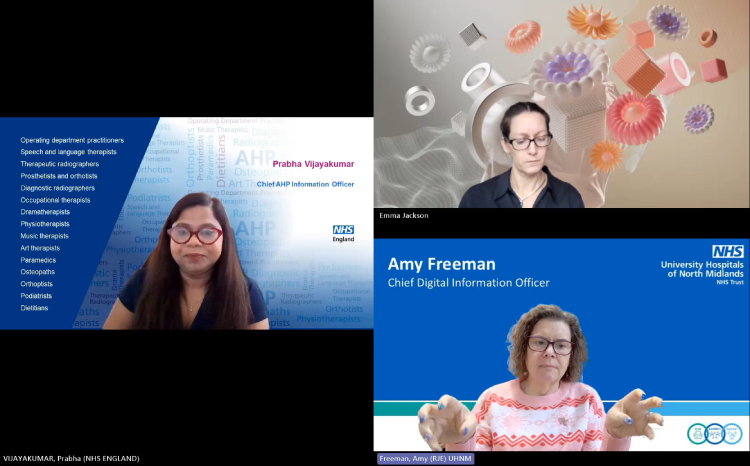
Speaking at Digital Health’s webinar on ‘AHPs and the digital commitments of the 10-year plan’ on 12 December 2025, Prabha Vijayakumar, chief AHP information officer at NHS England, said that NHSE has completed a digital maturity assessment for AHPs.
“The primary reason for us to do [it] was to establish an evidence-based baseline of digital capability across the allied health professions,” she explained.
Early findings of the assessment identified significant gaps in digital leadership, AI literacy and data analytics capabilities for AHPs.
Vijayakumar noted that AHP digital leadership roles are “mostly informal, lacking protected time and inconsistently banded or recognised nationally”, with 28% maturity nationally.
She added that AI and decision support literacy was at 38% maturity nationally, with limited awareness and minimal training across professions, and electronic patient record workflows which “are not necessarily or consistently AHP supportive”.
She also said that data analytics capability for AHPs is “patchy” at around 50% nationally.
“These gaps give us a clear need for investment, whether that is in leadership, representation or training and inclusion,” Vijayakumar said.
Emma Jackson, chief AHP and nursing information officer at Norfolk Community Health and Care and Cambridgeshire Community Services, highlighted innovation which is already underway, such as the rollout of electronic med fit notes.
She added that this is “a really good example of where we need to use the functionality that we have in a way that makes sense for our AHPs”.
Jackson urged AHPs to be “brave” and step forward into digital leadership.
“Go find your digital leads. Talk to them. Find your regional digital AHP interest group. Join that group. Join that conversation.”
Clinical safety was highlighted as a potential route into digital roles.
Amy Freeman, chief digital information officer at University Hospitals of North Midlands, described clinical safety as “a really good way of finding your voice at the table”, adding that clinical safety officers “are in scarce resource”.
“We are absolutely desperate for good jobbing people who can do clinical safety,” she said.
Freeman, who is also chair of the Digital Health Networks Chief Information Officer Advisory Panel, cautioned that AHPs should not try to solve digital problems alone.
“This is a team sport. You shouldn’t be going and looking for tools and solutions on your own.
“They need to be done with your digital colleagues and they should be done recognising the broader digital landscape,” she said.
Freeman also challenged assumptions around digitally excluded patients.
“Don’t not do something good because a small number of people can’t engage.
“We can serve them better by moving digital and then having a stream of work to mop up those who aren’t enabled,” she said.
Looking ahead to delivering the NHS 10 year health plan, Vijayakumar warned that AHPs cannot afford to stay on the sidelines.
“Digital is going to be the biggest player because we cannot keep doing what we’re doing and expect that it’s going to meet the needs of the workforce or going to meet the needs of the population or the services.
“Transform your patient care and use data to drive decisions,” Vijayakumar said.
You can watch the webinar on demand here.