
AI tool helps spot deadly clots in stroke patients faster, study shows
- 4 December 2025



- An AI imaging tool can help doctors spot deadly clots in stroke patients more than an hour earlier, a study has found
- Hospitals using the Brainomix 360 Stroke imaging tool saw thrombectomy rates double from 2.3% to 4.6%
- Receiving a thrombectomy doubles a a patient's chance of regaining independence after a major stroke
An AI imaging tool can help doctors spot deadly clots in stroke patients more than an hour earlier, a study has found.
The Brainomix 360 Stroke imaging tool, which has been rolled out in more than 70 NHS hospitals, helps doctors spot clots in minutes, speeding up clinical decision making and helping get patients rushed to specialist stroke centres faster.
This means that patients are more likely to receive a thrombectomy to remove the clot faster, doubling their chances of regaining independence after a major stroke.
An analysis, published in The Lancet Digital Health on 2 December 2025, found that 15,377 patients benefitted from having their scans reviewed using the AI tool from January 2022 onwards.
Dr David Hargroves, national clinical director for stroke at NHS England and co-author of the study, said: “This landmark study confirms what we have already been seeing in daily practice: that stroke AI imaging is helping us deliver faster decision-making and better care for our patients.
“This technology supports clinicians to make rapid treatment decisions, which means more patients can receive life – and disability-saving treatments in time – giving them a better chance of returning to independent living.
“This publication provides robust, real-world evidence of the impact of AI in stroke care and shows why the NHS moved quickly to roll this technology out nationwide.”
A total of 452,952 stroke patients, admitted to 107 hospitals in England between 1 January 2019 and 31 December 2023, were included in the national audit dataset, with 71,017 patients treated at the 26 evaluation hospitals included in the patient-level analysis.
Hospitals using the AI tool saw thrombectomy rates at participating sites double (from 2.3% to 4.6%), compared with smaller increases at hospitals not using the technology (1.6% to 2.6%).
Every 20-minute delay in thrombectomy cuts the chance of full recovery by around 1%. Without the rapid scan reading and swift transfer to a specialist stroke centre, many patients arrive too late to benefit.
At primary stroke centres, AI use was associated with a 64-minute reduction in door-in-door-out time.
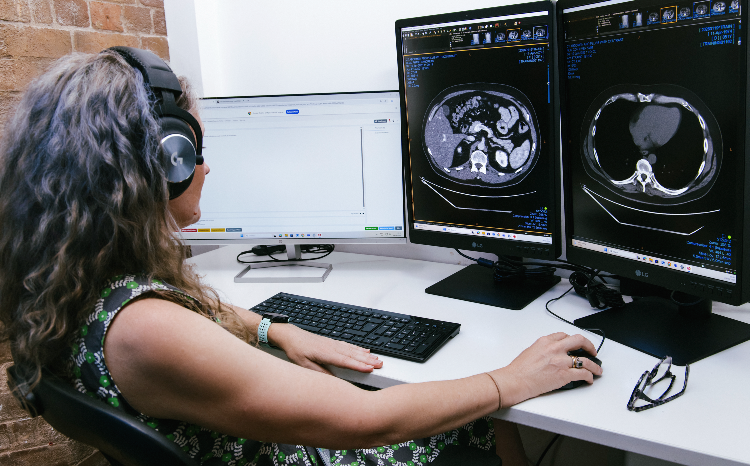
The AI platform analyses CT scans in real time, identifying key features of a major stroke within minutes.
This is particularly valuable in hospitals without on-site neuroradiology expertise, where rapid interpretation is critical, and where the study found the biggest improvements in treatment rates and transfer times.
The technology forms part of a wider NHS programme that has introduced AI decision-support across every regularly admitting stroke service in England. NHS England confirmed in December 2024, that all 107 stroke centres in England are now utilising AI technology.