
NHS funding to focus on non-acute settings, says England’s CCIO
- 24 March 2026


- Alec Price-Forbes, national CCIO at NHSE, confirmed that upcoming funding will be focused more on non-acute and community settings
- More ownership and power will be given to local providers, organisations and ICSs to spend that money
- The challenge around is to move from pockets of excellence to a consistent national standard of digital transformation, he said
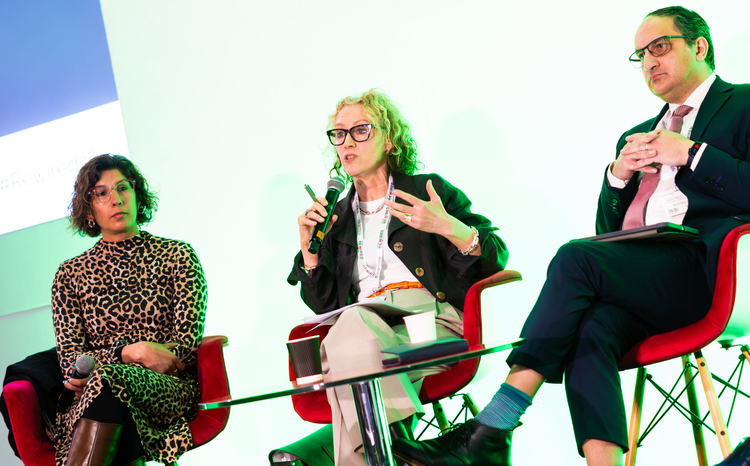
Upcoming funding from the centre will be focused more on non-acute and community settings, confirmed NHS England’s national chief clinical information officer (CCIO) at Digital Health Rewired.
Speaking in the opening keynote panel session on 24 March 2026, Alec Price-Forbes said that funding is coming which “will be focused very much, far more on non-acute settings and community settings”.
“We’ll also give more ownership and power to local providers and organisations, and ICSs integrated care systems] to spend that money,” Price-Forbes said.
“For the last 10-15 years, we’ve focused relentlessly on pouring 95% of the money… into hospital, and that’s got to change.
“We’ve got to stop just dealing with people that were brought out of the river of disease and actually left shift and start preventing them falling in the river of disease first,” Price-Forbes said.
Unpublished internal planning guidance from the Department of Health and Social Care and NHSE, reported on by Digital Health, pledged that 50% of £2.5bn funding for the frontline productivity programme would go into community settings.
The commitment is in line with one of the three key shifts in the government’s NHS 10 year health plan – shifting care from the hospital to the community.
Price-Forbes also emphasised the need for money to be spent “focusing on optimisation”, which is a key theme as NHS England moves its focus away from electronic patient record adoption.
“We’ve invested huge amounts of money, hardware, and resource, therefore the onus is to use taxpayers money wisely to ensure that our staff have the best possible training to use what in front of them,” Price-Forbes said.
He called for the NHS to “stop just digitising what we did on paper” and instead “strategically and purposefully” redesign how it does things.
“Our challenge and our opportunity is to move from pockets of excellence to a consistent national standard, scale what works, redesign the services around digital, and focus relentlessly on change management, people and benefits realisation, to make a more resilient, productive NHS,” Price-Forbes said.
Other speakers at the session echoed the need for a more flexible and locally driven approach to transformation.
Dr Indra Joshi, chief development officer at Optum UK, said that systems vary significantly in their digital maturity and cautioned that innovation must be built on strong foundations, warning that the NHS cannot effectively transform services if underlying systems are not fit for purpose.
Meanwhile, Dr Jennifer Dixon, chief executive of The Health Foundation, suggested that large-scale redesign may be difficult to deliver through a single national plan, arguing that “faster iteration” may be a more pragmatic route to change.
The session was chaired by Monica Fletcher, honorary senior research fellow at Nuffield Centre for Primary Care at the University of Oxford.
Digital Health Rewired is taking place 24-25 March 2026 at the NEC in Birmingham.