
NHS leaders call time on AI pilots and demand national scaling
- 15 June 2026


- At NHS ConfedExpo 2026 last week NHS leaders urged organisations to stop repeating AI pilots and scale proven technologies such as AVT
- Dr Shankar Sridharan, national clinical lead for AI at NHS England, said continued AVT pilots are "nuts"
- Panellists said successful AI adoption depends on people, leadership and change management
Senior NHS digital leaders have called for an end to repeated AI pilots across the health service, arguing that the focus must now shift to implementation and scaling proven technologies.
Speaking at NHS ConfedExpo 2026 at Manchester Central, panellists repeatedly criticised what they described as a culture of “pilotitis”, particularly around AI tools such as ambient voice technology (AVT), which automatically generates clinical notes and documentation from consultations.
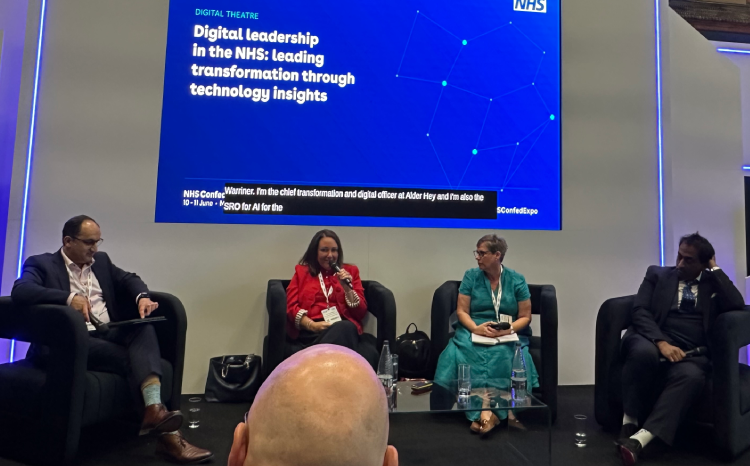
In a session on 10 June titled ‘Digital leadership in the NHS: leading transformation through technology insights’, Dr Shankar Sridharan, national clinical lead for AI at NHS England, questioned why organisations continue to run local pilots despite growing evidence of benefits.
“We showed that there’s massive benefits,” he said, referring to a large-scale evaluation of AVT at Great Ormond Street Hospital for Children, where he works as a consultant paediatric cardiologist.
The evaluation showed a 23.5% increase in direct patient interaction time during appointments, alongside an 8.2% reduction in overall appointment length when AI scribes were used.
“We didn’t have to do repeated pilots, because actually we all do pilots repeatedly, still of AVT, and that’s nuts. How much evidence is enough?”
He added: “That I think is the type of FOMO [fear of missing out]. ‘I’m really interested in AI; I’m going to do a pilot’. Really? Please don’t.”
His comments were echoed by Helen Balsdon, national chief nursing information officer at NHS England, who said the NHS must move beyond testing technologies and focus on adoption.
“I see so many pilots, so many pilots,” she said. “At what point does a pilot become a test of change? Do we start replicating and scaling even within an organisation?”
Balsdon argued that pilots should be viewed as a way of exposing staff to new technology rather than as an end in themselves.
“The technology at the heart of that doesn’t change, it’s about people,” she said.
Kate Warriner, chief transformation and digital officer at Alder Hey Children’s NHS Foundation Trust, pointed to the benefits of deploying technologies at scale.
She said that almost 90% of outpatient letters at Alder Hey Children’s NHS Foundation Trust are now generated using AVT, while Cheshire and Merseyside has expanded deployments across multiple trusts, with seven now live.
The panel agreed that successful adoption depends less on the technology itself and more on leadership, workforce engagement and investment in change management.
Sridharan argued that NHS organisations often fund software but fail to invest sufficiently in the people needed to implement it.
“We pay for the tech, but we don’t pay for people,” he said, adding that the NHS is “fundamentally bad at strategic delivery”.
Later in the session, he warned that the NHS was also falling behind in its use of generative AI tools.
“How many of you guys, put your hands up, have used an LLM at home? ChatGPT, OpenAI?” he asked the audience, concluding that “probably most” do “because it’s incredible – they can summarise, they can create insight”.
“The NHS has a whole time workforce of 1.37 million people, including me and you, and none of you are allowed to use LLMs at work. That’s criminal,” he told attendees.
“And so, we look at what’s next, and what’s next is agentic capability, but we can’t even put in AVT. And this isn’t NHS England’s fault alone, it’s all of us.
“We need to go back to our hospitals and say… can we work out working coherently? Can we actually adopt this at scale? Because it doesn’t work if five of us use it at a hospital and we kind of need to stop doing pilots.
“The time has come to move together,” Sridharan added.