
Panasonic launches new Mobile Clinical Assistant
- 25 March 2009


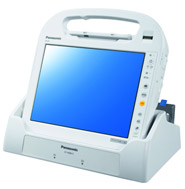 |
| Panasonic’s new Mobile Clinical Assistant, the Toughbook CF-H1 MCA |
Panasonic has launched the latest version of its Mobile Clinical Assistant, a rugged tablet-style wireless handheld computer specifically designed for use by clinicians.
The new MCA has been designed with extensive feedback from NHS nurses, who have influenced the shape of the strap and the position of the camera, bar-code reader and RFID scanner.
Developed as a rugged fully-sealed unit, the CF-H1 MCA dispenses with a fan, in an effort to cut down on the potential for spreading infections. It prompts users to clean it when it needs disinfecting.
It also comes with a free smart card reader that can be used with the next generation of proximity NHS smart cards. The new MCA comes with a pricetag equivalent to a high-end laptop.
Panasonic’s new MCA was designed through consultation, testing and field trials with more than 100 acute and community nurses.
Dr Mike Bainbridge, NHS Connecting for Health’s clinical architect said: “The MCA pilots we’ve seen have shown massive benefits in terms of quality of care and in cost as well. They will reduce cost and errors in the prescribing process and drug administration process.”
The nurses identified problems they had experienced with current medical laptops and MCAs, such as weight, battery life, and user comfort. Panasonic’s design process was built around this feedback. It included more than 50 different revisions of the handle design alone.
Jonathan Tucker, product head at Panasonic Toughbook, said: “In addition to improving durability, ease of use and product weight, we also worked on finding solutions for practical or clinical issues, such as including a camera on the MCA so that visual records could be kept of the patients’ conditions, either for monitoring or legal purposes.”
Barbara Stuttle, CfH’s national clinical lead for nursing, said: “I have been in nursing for 30 years or more and this is the first time that I am aware of that nurses have been consulted as deeply and have been as involved in the design process of something like this.
“It makes nurses more efficient because they don’t have to write something down in one place, then enter it on a computer somewhere else; they are only ever writing any note down once.”
Stuttle said that by the time she retired in three years’ time she wanted to see MCAs and similar devices widely used. “I want to see community clinicians using MCAs, and hospital nurses no longer sharing computers.” She also told E-Health Insider that she wanted to see built-in GPS tracking functions to help protect NHS staff.